Cytiva
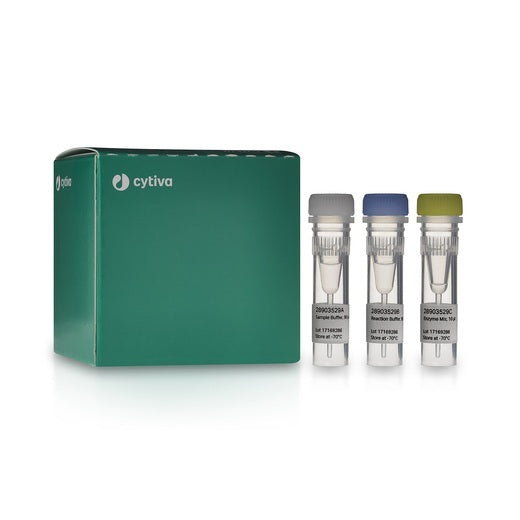
TempliPhi sequence resolver kit, 200 reactions
pack of 200
- Product overview
Overview
TempliPhi™ Sequence Resolver Kit resolves most of the sequencing stops or gaps that routinely elude other commonly used finishing methods. The use of this kit eliminates the need to use dGTP chemistry, which can affect the accuracy of a sequence due to the appearance of sequence compression. In addition, it eliminates the need for additives in the sequencing reaction.
•For the amplification of difficult templates for successful DNA sequencing.
•Solve the most common sequencing problems such as repeats, sequencing stops, and compressions with a single kit.
•Improve difficult template sequencing success with up to 820 bp Phred 20 read length.
•Cultureless preparation from bacterial colonies, glycerol stock or purified DNA; saves time and reagents.
•Easy-to-use kit requires only 20 min hands-on time.
•Amplified DNA can be directly used in sequencing reactions.
•TempliPhi Sequence Resolver Kit produces exceptional sequencing results from difficult templates such as those with high GC content and secondary structures.
•The kit resolves most of the sequencing stops or gaps that routinely elude other commonly used finishing methods.
Trends in rolling circle amplification: Capabilities for manipulation, error free production and assembly of nucleic acids are advancing.
Description
The kit can be used with both small (e.g., plasmids and M13) and large (fosmids and bacterial artificial chromosomes [BACs]) circular templates. The starting template for the reaction can be purified DNA, glycerol stock, liquid culture, or colonies. The reaction takes less than 20 min to prepare and after an overnight incubation at 10°C, it is ready to be used directly in sequencing applications with the sequencing chemistry of choice. A ten microliter (10 µl) reaction typically yields 1 µg of DNA in a standard overnight reaction.