R-Biopharm
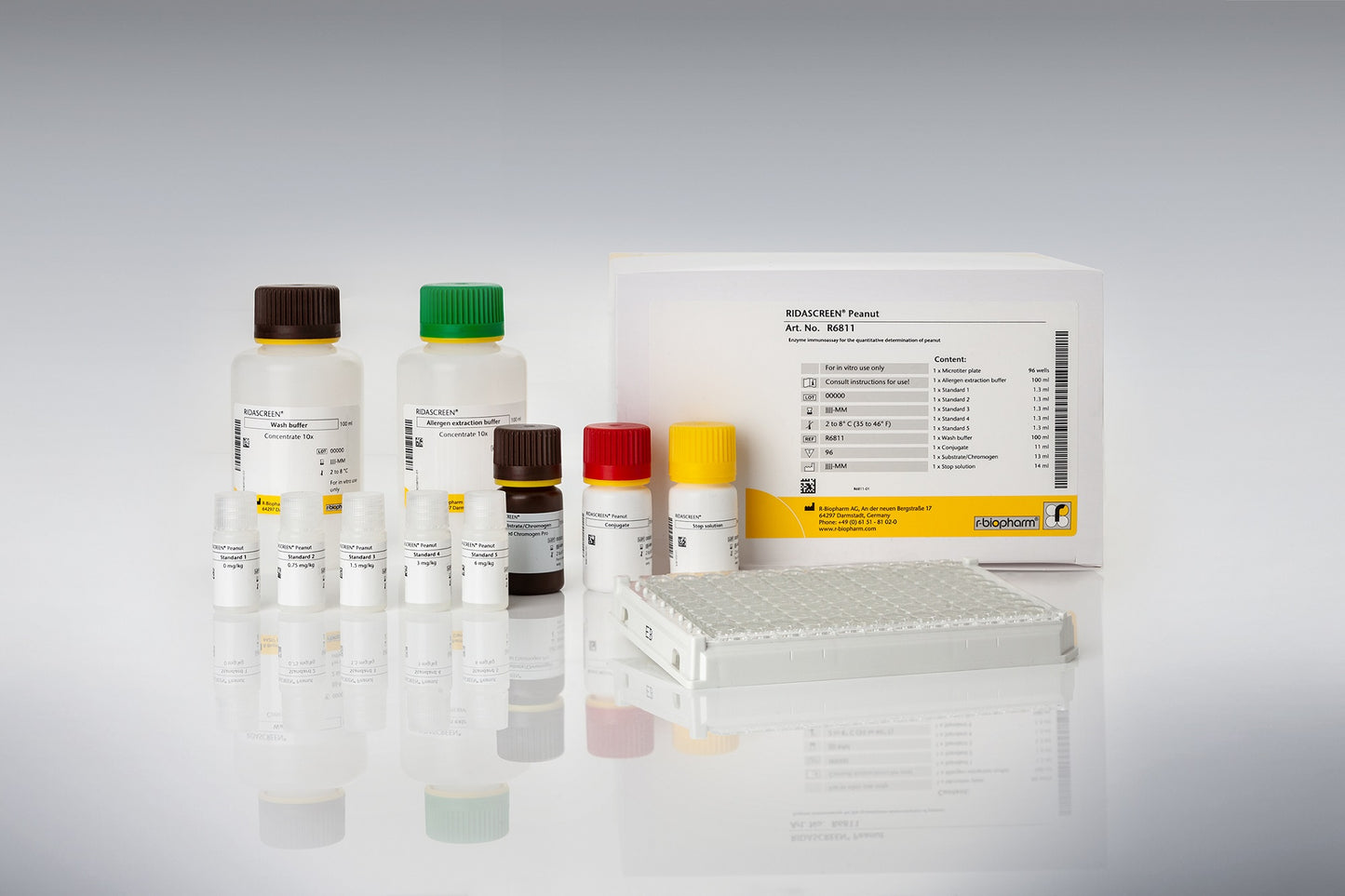
RIDASCREEN® Peanut
Sales unit:
Each
enquire now
Questions? We’re here to help.
- Product overview
Product overview
Intended use:
RIDASCREEN® Peanut is a sandwich enzyme immunoassay developed for the quantitative analysis of peanut or peanut proteins in food. Due to the large number of different food products, the following samples were examined representatively for different product groups within the scope of the test development: breakfast cereals, granola bar, cookies, ice cream and chocolate. It can be assumed that the assay is also suitable for the analysis of other foods; this must be checked by the user himself. The system is specific for roasted peanuts and over detects raw or slightly roasted peanuts.Specifications:
- Test format: Microtiter plate with 96 wells (12 strips with 8 removable wells each)
- Sample preparation: Homogenization, extraction and centrifugation
- Incubation time: 50 min Room temperature
- LOD (Detection limit): 0.15 mg / kg (ppm) peanut (mean) 0.033 mg / kg (ppm) peanut protein
- LOQ (Limit of quantification): 0.75 mg / kg (ppm) peanut 0.166 mg / kg (ppm) peanut protein
- Cross reactivity:
No cross reactivity in 91 commodities
- Validated matrices: Breakfast cereals, granola bar, cookies, ice cream and chocolate
- Detected analyte: Peanut proteins
- Evaluation: Microtiter plate spectrophotometer (450 nm)
- Related products: SureFood® ALLERGEN Peanut
General Information:
Although peanut (Arachis hypogaea) belongs to the legumes and not to the nuts, its taste and its usual consumption is similar to tree nuts. So to speak, peanut is one of the most popular “nuts” worldwide. Peanuts are very common ingredients of chocolate products and are also consumed as snacks and in bakery products such as cookies. Peanut is also one of the five foods, which are the most frequent cause of food allergies. Allergies against peanuts are among the most severe allergies and can lead to life-threatening anaphylactic shocks. Consumption of probably less than a milligram of peanut can induce allergic reactions in very sensitized individuals. Therefore, labelling of peanut containing products is very important and compulsory in the USA and the European Union as well as in many other countries. The main threat for sensitized individuals is contamination of peanut in food which is intended to be peanut-free (e.g. peanut traces in chocolate which should not contain peanuts). Therefore, it is important to test foods which may have been contaminated during their production process for the presence of unintended traces of peanuts. The allergen can be present as an ingredient or as a contamination in raw and cooked products. According to the regulation (EU) No. 1169/2011, peanut and products thereof must be declared on food labels. Similar regulations exist e.g. in the USA, Canada, Australia and New Zealand.
Benefits:
- AOAC-RI 112102 validated method.
- Unified wash buffer: no special wash buffer anymore.
- More sensitive analysis than the former RIDASCREEN®FAST Peanut (R6202).
- Widespread testing for cross reactivity (no cross reactivity with 81 commodities).
- Test procedure improved for automation; validation available for: ThunderBolt® and ChemWell®.
* all dates are estimates